
Money words for kids: what each one means
Money words for kids are the few short words a young child needs first: earn, spend, save, give, need, want and price. Each has a child’s sentence, a plain meaning, and the place in the game where it is practised.

By the Pocketvale team. Published 14 November 2026, updated 14 November 2026.
Key takeaways
- Seven short words come first: earn, spend, save, give, need, want and price.
- Each has a child’s sentence, a plain meaning and a place in the game where it is practised.
Getting money
- Earn
- “I earned my coins by doing a job.”
- To earn is to get money for doing something that someone wants.
- In the game, every coin comes from something the child did, and the village job board shows each job with its pay. More: where money comes from.
- Chore
- “I laid the table, and that is my chore.”
- A chore is a job that helps the home run. Some families pay for extra jobs and some do not.
- The job board in the game asks only for things a child has already learned to do. More: chores for 4 to 7 year olds.
- Pocket money (also: allowance)
- “I get pocket money each week to practise choosing.”
- Pocket money, called an allowance in the US, is a small, regular amount of money that is a child’s own to choose with.
- The game gives a child pretend coins to make the same choices many times, beside real pocket money. More: pocket money for young children.
Choosing what to do with it
- Need
- “My pet needs food before it can play.”
- A need is something you must have to live and be well, such as food.
- In the pet corner, a hungry pet gets food first, and the ball waits. More: needs and wants.
- Want
- “I want the bouncy ball, but it can wait.”
- A want is something nice to have, but you can live and be well without it.
- The shop holds more than one purse can buy, so a child chooses between wants. More: needs and wants.
- Spend
- “I spent my coins on a ball, so they are gone.”
- To spend is to hand money over for something. Once it is spent, the money is gone.
- A child’s coins can go to the purse, the wish jar or the giving box, and spent coins leave the purse. More: the spend, save and give jars.
- Price
- “The ball costs more than the apple.”
- A price is how much money a thing costs. It can change from day to day and from shop to shop.
- In the game, a thing fetches a different price from different buyers, and the game shows who pays the most today. More: sales and the best price.
- Sale
- “The ball is on sale, so it costs less today.”
- A sale is a short time when a shop charges less. It only helps someone who has already saved.
- Every fourth day, the dearest thing on the shop’s shelf shows its old price struck through. More: sales and the best price.
- Change
- “I counted the change back to my customer.”
- Change is the money you give back when someone pays with more than the price.
- At the market stall, a child counts each coin onto the stall for the customer. More: selling at a stall.
Keeping it and giving it
- Save
- “I am saving my coins for a big wish.”
- To save is to keep money now so you can have something bigger later.
- A child picks a wish, and its jar fills one coin at a time where the child can see it. More: saving for a goal.
- Goal
- “My goal is a sofa for my pet’s home.”
- A goal is the thing you are saving for. A goal you can see makes the waiting easier.
- When the wish jar is full, the wish can be bought, and it stays in the home. More: saving for a goal.
- Give
- “I gave some of my coins to plant a tree.”
- To give is to let some of your money help someone else, as your own choice.
- The giving box, the village chest and the village fund are three places a child can give, and each is the child’s choice. More: teaching kids about giving.
Waiting and borrowing
- Patience (also: delayed gratification)
- “I waited for my seeds to grow, and got more.”
- Patience is choosing to wait for something better instead of taking something smaller now.
- In the garden, seeds grow over real days, and a crop left to grow is worth more than one picked early. More: delayed gratification.
- Borrow
- “I borrowed coins, and I must give back a little more.”
- To borrow is to have money now and pay back more later. The extra is the price of not waiting.
- The village bank lends coins, and it says what borrowing costs before anything moves. More: teaching kids about borrowing.
- Interest
- “My coins in the bank grew a little extra.”
- Interest is the extra money a bank gives you for saving, or asks you for when you borrow.
- At the village bank, full jars of coins earn a little extra each week, and the extra coin can be seen. More: explaining interest.
How we wrote this
- We lean on official guidance. It is linked under Sources, and named in the text.
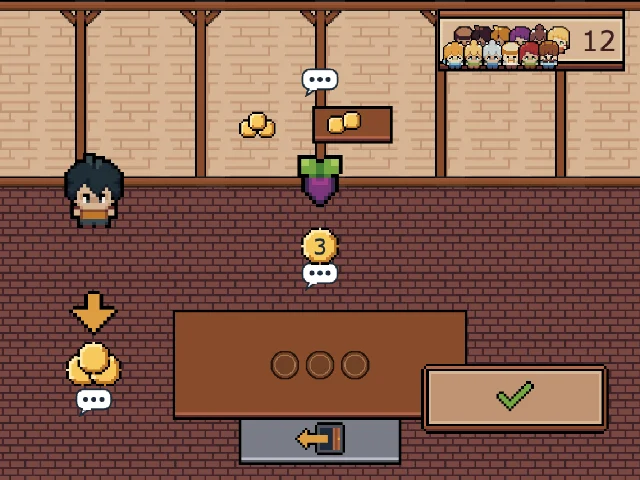
- Every picture of the game is a screenshot from the game itself.
- We make Pocketvale, so the sections about the game carry its name.
- Each page shows the day it was last changed.
- We are not financial advisers, and every family is different.
Who writes these guides
Pocketvale is made by a parent and software engineer, as a family project. We write these guides to share what building a money game for children aged 4 to 8 taught us.
Spotted a mistake? Tell us through the contact form. More about Pocketvale.
Practise the words in the game
Free to play in the browser, on an iPad, a tablet or a computer. No ads, no sign-up.
 Play Pocketvale
Questions parents ask
Which money word should a child learn first?
Earn. It is the word before all the others, because money comes from doing something that someone wants. After it come spend, save and give.
How do I teach a money word to a young child?
Say it next to coins the child can see and hold. Use the child’s sentence on this page, then do the thing once, with a few real coins.
More guides: how to teach kids about money, needs and wants, saving for a goal, all the guides.