 Pocketvale
Money lesson for kindergarten: needs and wants
A need is something we must have to be safe, fed and well. A want is something we would like. The difference is the first real choice about money a child makes.
By the Pocketvale team. Published 2 November 2026. For ages 4 to 8. About fifteen minutes: five of talk and ten of play.
The idea: A need comes first. A want is fine, and it can wait.
What a child says back: “Food is a need. The ball is a want, and it waits.”
Five minutes of talk
- Hold up a lunch box and a toy. Ask: “Which one do we need to feel well today?” Say the word: a need.
- Hold up the toy again. Say: “We would like it, but we can live well without it today. That is a want.” Wants are not bad.
- Play the fast game. Say “a coat in the snow”, “a sticker”, “water”, “a game on a tablet”. Children stand up for a need and sit for a want.
- Ask about the tricky one: “A new pair of shoes when yours are too small?” Let them argue. The answer can change with the day.
- Say it back together: “A need comes first.” Then go and play.
The game screen that shows it
In the pet corner a hungry pet sits next to a bowl of food and a bouncy ball. While the pet is hungry the game asks what the pet needs first, and the ball waits: “Food first!” Once the pet has eaten, the same ball is for sale again. The want is not wrong. It is second. Food is cheap and the ball is dear, so a child with only a few coins can always choose well.
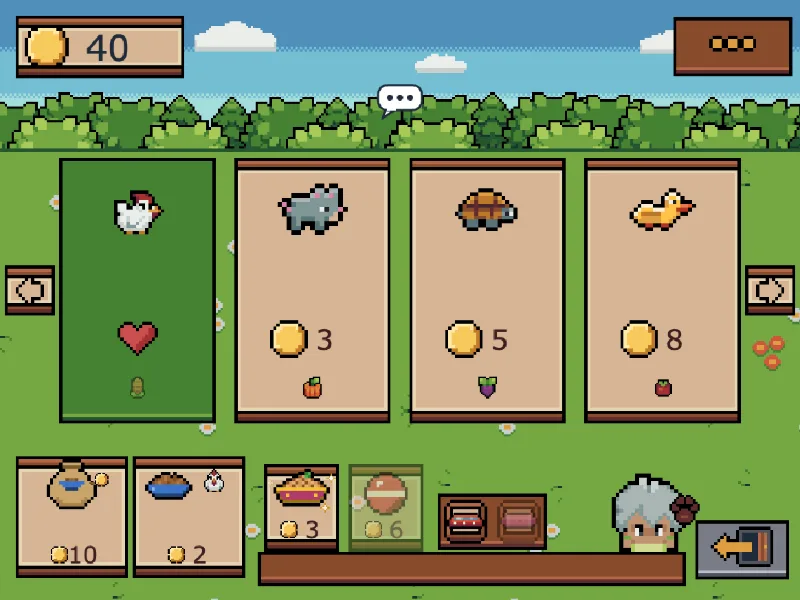
What a child does there, in about ten minutes:
- A child sees the hungry pet and the two prices.
- The child chooses what to buy first, and hears what the game says on reaching for the ball.
- After the pet has eaten, the ball is bought and the pet plays.
Pocketvale is a free browser game for children of about 4 to 8. It needs no account, shows no ads and plays on a tablet, a Chromebook or a computer. A child can play it on one device, or you can add it to your class page.
Print it
The needs and wants sort is a set of picture cards to cut out and place in two groups, using the same pictures as the game. Print the needs and wants sort, free and ready to use.
What to listen for
- A child who says “food first” without being asked.
- A child who calls a want “fine, but later”.
- A disagreement about a tricky card. That is the best part of the lesson, so leave time for it.
Standards this lesson meets
Read off each standard’s own document on 13 November 2026. Most early money standards go further than one fifteen-minute lesson, so most of these are met in part.
- US National Standards (CEE and Jump$tart), Spending 4-1 (covers part of it): “People differ in their preferences, priorities, and resources available for consuming goods and services.”
- US National Standards (CEE and Jump$tart), Spending 4-3 (covers part of it): “When people make a decision to use money for a particular purpose, they incur an opportunity cost in that they cannot use the money for another purpose.”
- Australian Curriculum v9 F-2, AC9M1N05 (covers part of it): “use mathematical modelling to solve practical problems involving additive situations, including simple money transactions; represent the situations with diagrams, physical and virtual materials, and use calculation strategies to solve the problem”
The standards table has every row, including the ones no lesson meets, with links to the documents.
Read more for grown-ups
The article that covers this idea for parents and teachers is Needs and wants for kids. You can send it home with the lesson.
Try this lesson’s screen yourself
Free to play in the browser, on an iPad, a Chromebook or a computer.
 Play Pocketvale
Questions teachers ask
Are wants bad?
No. A want is something we would like, and wanting things is normal. The lesson is the order: needs first, then wants, and some wants have to wait for coins.
What if two children disagree about a card?
Good. Ask each to say why. Many things are a need for one family and a want for another, and the talking is the lesson.
Before this: saving for a wish. Next: interest and the bank. All six lessons are on the teachers page, and a week of them is the Financial Literacy Month plan.