 Pocketvale
Money lesson for kindergarten: what interest is
Interest is a hard word and an easy picture. Leave coins with a bank for a while and the bank adds a few more. A child can watch a coin arrive that nobody earned.
By the Pocketvale team. Published 2 November 2026. For ages 4 to 8. About fifteen minutes: five of talk and ten of play.
The idea: A bank pays us a little extra for leaving our coins with it, and it likes the jars full.
What a child says back: “I left my coins in the bank, and the bank gave me one more.”
Five minutes of talk
- Ask: “Where can you keep coins that is safe?” Take answers: a pocket, a jar, a piggy bank. Say that a bank is a safe place that many people share.
- Put five counters in a clear jar. Say: “Five coins, one jar.” Put the jar on a shelf and say that the coins will wait there.
- Say: “The bank says thank you for leaving them. After a while it adds one more coin.” Add one counter and let them count the jar again.
- Ask: “Why do you think the bank does that?” Accept anything. A simple answer is that the bank uses the coins and shares a little back.
- Say it back together: “I left my coins, and I got one more.” Then go and play.
The game screen that shows it
The village bank keeps coins on a shelf in glass jars of five. There are no balances to read: a child counts jars and coins. Every two full jars make one more coin, paid once a week. A part-full jar makes nothing, so the first thing a child learns about interest is that it rewards filling the jar. The word “interest” is only ever said next to the extra coins a child can see.
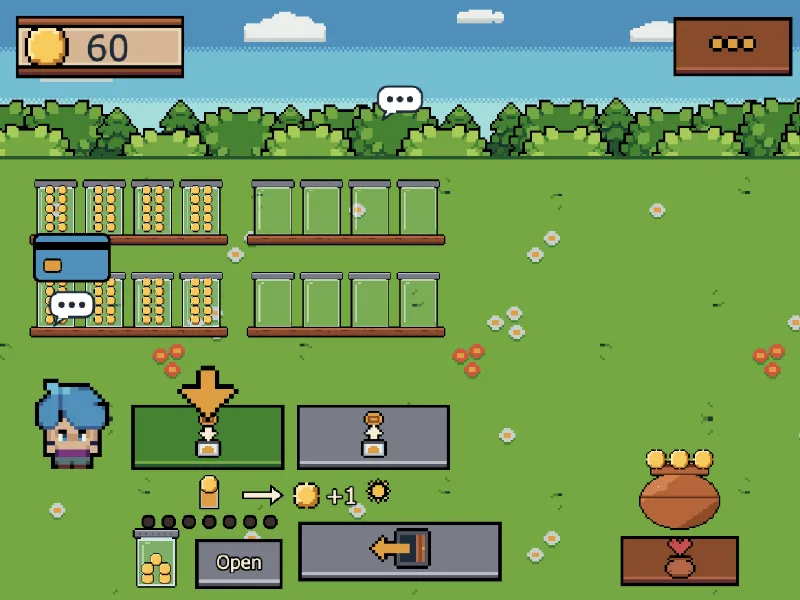
What a child does there, in about ten minutes:
- A child puts coins on the shelf, five to a jar.
- A second jar fills, and a sign shows two full jars making one more coin.
- On another day, a coin has arrived that nobody earned.
Pocketvale is a free browser game for children of about 4 to 8. It needs no account, shows no ads and plays on a tablet, a Chromebook or a computer. A child can play it on one device, or you can add it to your class page.
Print it
The piggy bank coloring page is a quiet follow-up: children colour the bank, and say what it is for. Print the piggy bank coloring page, free and ready to use.
What to listen for
- A child who says the extra coin came “because I waited”.
- A child who wants to fill the second jar to get the extra coin.
- A child who asks where the coin came from. That is a good question. Say “the bank pays you for saving”.
Standards this lesson meets
Read off each standard’s own document on 13 November 2026. Most early money standards go further than one fifteen-minute lesson, so most of these are met in part.
- US National Standards (CEE and Jump$tart), Earning Income 4-5 (covers part of it): “People can earn income by lending money or by renting their property to others.”
- US National Standards (CEE and Jump$tart), Saving 4-5 (covers it): “Financial institutions often pay interest on deposit accounts to attract customers to deposit money in their institution.”
- US National Standards (CEE and Jump$tart), Credit 4-1 (covers part of it): “Interest is the price a borrower pays for using someone else’s money, and the income earned by the lender.”
- Australian Curriculum v9 F-2, AC9MFN06 (covers part of it): “represent practical situations involving equal sharing and grouping with physical and virtual materials and use counting or subitising strategies”
- Australian Curriculum v9 F-2, AC9M2N06 (covers part of it): “use mathematical modelling to solve practical problems involving additive and multiplicative situations, including money transactions; represent situations and choose calculation strategies; interpret and communicate solutions in terms of the situation”
The standards table has every row, including the ones no lesson meets, with links to the documents.
Read more for grown-ups
The article that covers this idea for parents and teachers is How to explain interest to a child. You can send it home with the lesson.
Try this lesson’s screen yourself
Free to play in the browser, on an iPad, a Chromebook or a computer.
 Play Pocketvale
Questions teachers ask
Do five-year-olds really understand interest?
Not the word, at first. They understand the picture: the row of coins gets longer when they wait. The word can follow once they have seen it a few times.
Does the game teach borrowing too?
Yes. The bank lends a few coins, and a child pays back a little extra, a coin at a time during play. The guide linked below explains both sides for grown-ups.
Before this: needs and wants. Next: making things worth more. All six lessons are on the teachers page, and a week of them is the Financial Literacy Month plan.