 Pocketvale
Money lesson: making things worth more
A lump of clay is worth a little. A pot made from it is worth more. Work and care add worth, and a child can see the difference in coins.
By the Pocketvale team. Published 2 November 2026. For ages 4 to 8. About fifteen minutes: five of talk and ten of play.
The idea: When we make something, it can be worth more than the things we made it from.
What a child says back: “The clay was two coins, and the pot was five.”
Five minutes of talk
- Show a lump of play-dough and a pot you have made from it. Ask: “Which would you rather buy?” Say that the pot took work and care.
- Say what the dough cost: “This lump cost two coins.” Say what a pot like this sells for: “And a pot like this sells for five.”
- Ask: “How many more coins is the pot worth?” Let them lay out two counters and five counters and compare the rows.
- Ask: “What if the pot wobbles?” A wobbly pot sells for less, but still more than the clay. Care is paid.
- Say it back together: “Making can make something worth more.” Then go and play.
The game screen that shows it
At the potter’s yard a child buys a lump of clay for two coins. The child holds to spin the wheel and lift the pot, and lets go in the green band. A fine pot sells for seven coins, a good one for five and a lopsided one for three, and every pot sells for more than its clay. The game says the difference out loud, so profit is the coins left over after the cost. A slip is never a loss.
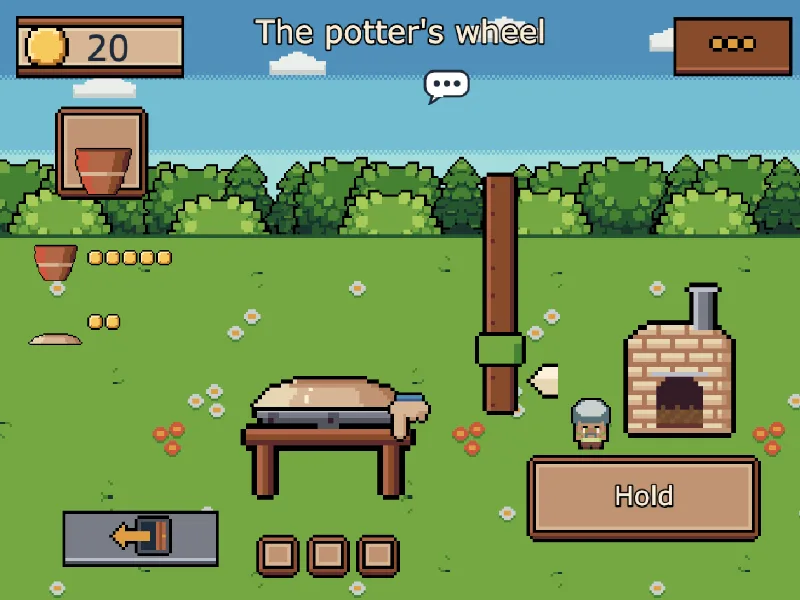
What a child does there, in about ten minutes:
- A child buys a lump of clay and sees its price.
- Hold to lift the pot, let go in the green, and the pot grows each lift.
- The pot is sold, and the game says how many coins were made after the clay.
Pocketvale is a free browser game for children of about 4 to 8. It needs no account, shows no ads and plays on a tablet, a Chromebook or a computer. A child can play it on one device, or you can add it to your class page.
Do it without a screen
There is no printable for this lesson, because the best version is made of something. Give each child a lump of play-dough with a price tag of two. Let them make a pot, then sell it to you for a price you set by how well it was made. Ask them to count what they made.
What to listen for
- A child who compares the pot with the clay and says which is worth more.
- A child who says that a careful pot sells for more.
- A child who counts the difference. Cost and profit can wait for later years: here the picture is enough.
Standards this lesson meets
Read off each standard’s own document on 13 November 2026. Most early money standards go further than one fifteen-minute lesson, so most of these are met in part.
- US National Standards (CEE and Jump$tart), Earning Income 4-4 (covers part of it): “People can earn income by starting a new business as an entrepreneur or by owning a business.”
- England KS1 maths, Year 2, Measurement (covers part of it): “solve simple problems in a practical context involving addition and subtraction of money of the same unit, including giving change”
- Australian Curriculum v9 F-2, AC9MFN05 (covers it): “represent practical situations involving addition, subtraction and quantification with physical and virtual materials and use counting or subitising strategies”
- Australian Curriculum v9 F-2, AC9M1N05 (covers part of it): “use mathematical modelling to solve practical problems involving additive situations, including simple money transactions; represent the situations with diagrams, physical and virtual materials, and use calculation strategies to solve the problem”
The standards table has every row, including the ones no lesson meets, with links to the documents.
Read more for grown-ups
The article that covers this idea for parents and teachers is How to teach kids about money, age by age. You can send it home with the lesson.
Try this lesson’s screen yourself
Free to play in the browser, on an iPad, a Chromebook or a computer.
 Play Pocketvale
Questions teachers ask
Is this about making a profit?
In a gentle way. The idea is that work and skill add worth. Later, children can call the left-over coins profit. For now it is “what I made after the clay”.
Are there other places in the game where things grow worth more?
Yes. A seed planted in the garden grows into a crop that is worth more than the seed, if the child waits. The garden’s chart shows a small crop growing into a big one.
Before this: interest and the bank. Next: giving. All six lessons are on the teachers page, and a week of them is the Financial Literacy Month plan.