 Pocketvale
Money lesson for kindergarten: giving
Spend, save and give is the three-jar idea most children meet first. Giving is the one that never comes back in coins, and the one children are proudest of.
By the Pocketvale team. Published 2 November 2026. For ages 4 to 8. About fifteen minutes: five of talk and ten of play.
The idea: We can give some of our money to make something good for other people.
What a child says back: “I gave coins, and now everyone has a bench.”
Five minutes of talk
- Ask: “Has anyone ever given you something?” Take a few answers and ask how it felt. Then ask how it felt to give.
- Ask: “If our class had five coins to give, what could they make for everyone?” Suggestions will be small and kind.
- Hold up three jars labelled spend, save and give. Ask which jar the coins from a job could go in. They can go in any of the three, and the choice is theirs.
- Say that when we give, the coins do not come back. What comes back is the thing itself, a bench, a tree or a lamp, that we can see.
- Say it back together: “I can give.” Then go and play.
The game screen that shows it
In the village park there is a giving box. A box beside a bare patch of ground is a job that wants doing, and nobody is asking for help. One tap puts in one coin, and five coins make a gift: a little tree, a lamp for the dark, a bench to sit on. Once the first three stand, the box asks for one new small thing each week. Nothing ever comes back in coins, and giving is always the child’s own choice. After the first gift a sign with the child’s name stands in the park.
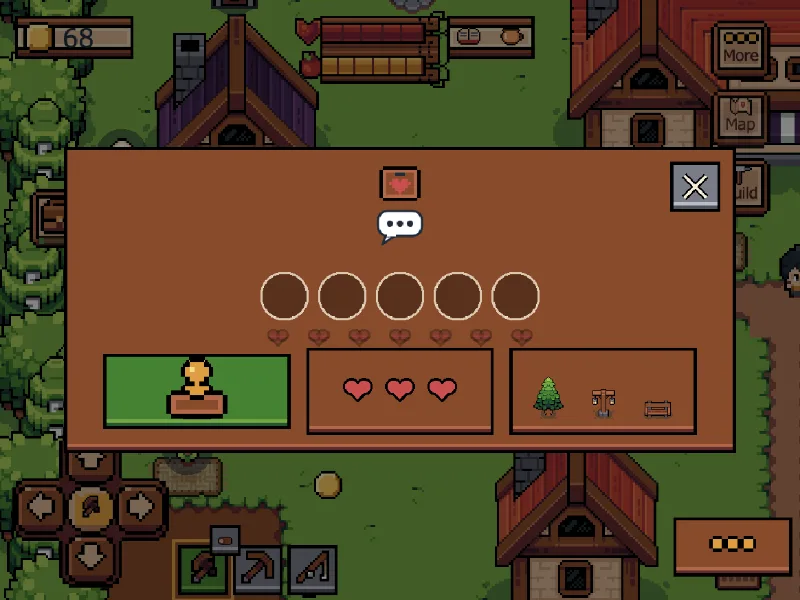
What a child does there, in about ten minutes:
- A child opens the box and taps coins in, one at a time.
- At five coins a gift is made, and it stands in the park for everybody.
- Next week there is a next small thing to come back for.
Pocketvale is a free browser game for children of about 4 to 8. It needs no account, shows no ads and plays on a tablet, a Chromebook or a computer. A child can play it on one device, or you can add it to your class page.
Do it without a screen
There is no printable for this lesson. Run a class giving project instead: agree on one small thing to make for others, such as cards for a care home or a donation box for the library. Let the children decide what it is.
What to listen for
- A child who names who the gift is for.
- A child who says it felt good to give. Do not push for this. It does not have to come.
- A child who asks what comes back. Say that what comes back is the thing itself, and leave time to think.
Standards this lesson meets
Read off each standard’s own document on 13 November 2026. Most early money standards go further than one fifteen-minute lesson, so most of these are met in part.
- US National Standards (CEE and Jump$tart), Spending 4-2 (covers part of it): “Money can be spent to increase one’s own or another individual’s personal satisfaction or to share the cost of goods and services.”
- Australian Curriculum v9 F-2, AC9M2N06 (covers part of it): “use mathematical modelling to solve practical problems involving additive and multiplicative situations, including money transactions; represent situations and choose calculation strategies; interpret and communicate solutions in terms of the situation”
The standards table has every row, including the ones no lesson meets, with links to the documents.
Read more for grown-ups
The article that covers this idea for parents and teachers is Financial literacy for kindergarten and preschool. You can send it home with the lesson.
Try this lesson’s screen yourself
Free to play in the browser, on an iPad, a Chromebook or a computer.
 Play Pocketvale
Questions teachers ask
Is giving ever taken from a child?
Never. Nothing a child owns is taken away, and the box only takes what is put in. A neighbour may mention that the village is saving, but giving is always the child’s own choice.
Why does the game give nothing back for a gift?
Because a gift that pays is really a purchase, and children notice. What comes back is the tree, the lamp or the bench itself.
Before this: making things worth more. All six lessons are on the teachers page, and a week of them is the Financial Literacy Month plan.