 Pocketvale
Free printable wish list for kids
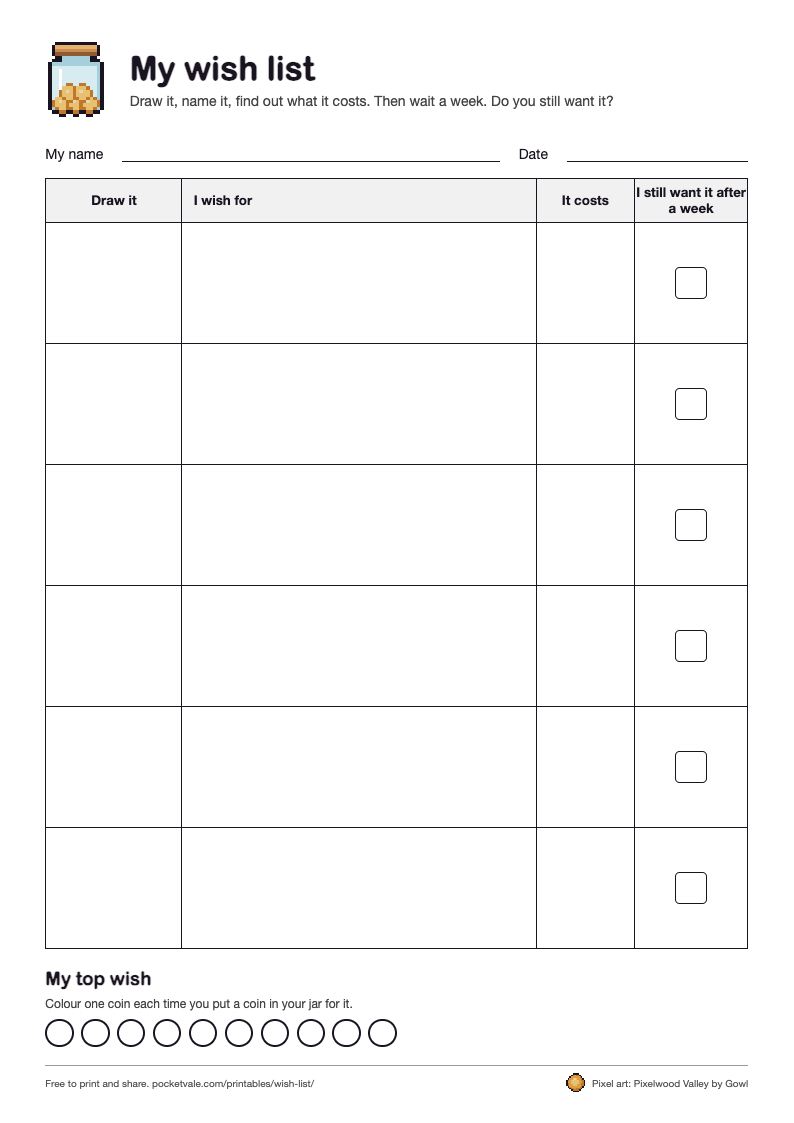
A one-page wish list with a drawing box, a name, a price and a tick for "I still want it after a week". It helps a child ask for what they want, and see which wishes last.
By the Pocketvale team. Published 2 November 2026.
Download the PDF
1 page, black line on white paper, so it uses very little ink. It has room for six wishes and a coin row for the top one.
Free to print and share at home or in class. No sign-up, no email, no ads.
What is on the page
Six rows, each with a box to draw the wish, a line to say what it is, a space for the price and a tick box headed "I still want it after a week". Below is a coin row for the top wish, with ten circles to colour as the coins go into the jar.
Why a wish list, and why wait a week
Young children want things the moment they see them. A wish list gives that feeling somewhere to go. Writing or drawing the wish is a tiny pause, and the week's wait is a longer one. When a week has passed, many wishes have faded, and the ones that are still wanted are the real ones. It teaches, in a way a child can feel, that a want is not the same as a need, and that waiting is part of choosing well.
The wait is the heart of it. Our guide to delayed gratification for kids explains why waiting is a skill that can be practised, and how to make it easier.
How to use it
- Draw the wish. A quick drawing is enough, and it helps a child who cannot yet write.
- Name it and find the price. Look it up together, in a shop or online, and write it down. Seeing a price is a lesson in itself.
- Wait a week. Leave the sheet on the fridge. Date it at the top so everyone knows when the week is up.
- Ask the question. After a week, ask "Do you still want it?" and let your child tick the box, or not.
- Pick one wish to save for. Use the coin row, or move to the savings tracker, and start putting coins in a jar.
Making the wish list work
- Saying "put it on the list" is not saying no. It is a way of saying "let us think about it", and children often accept it happily.
- Keep birthdays and holidays in mind. A wish list is useful for relatives who ask what to give.
- Mix prices. A child who sees both a ten-coin wish and a hundred-coin one starts to understand what saving up means.
- Cross wishes off without fuss. A wish that was dropped is a success, because the child decided it was not worth it.
A wish list in Pocketvale
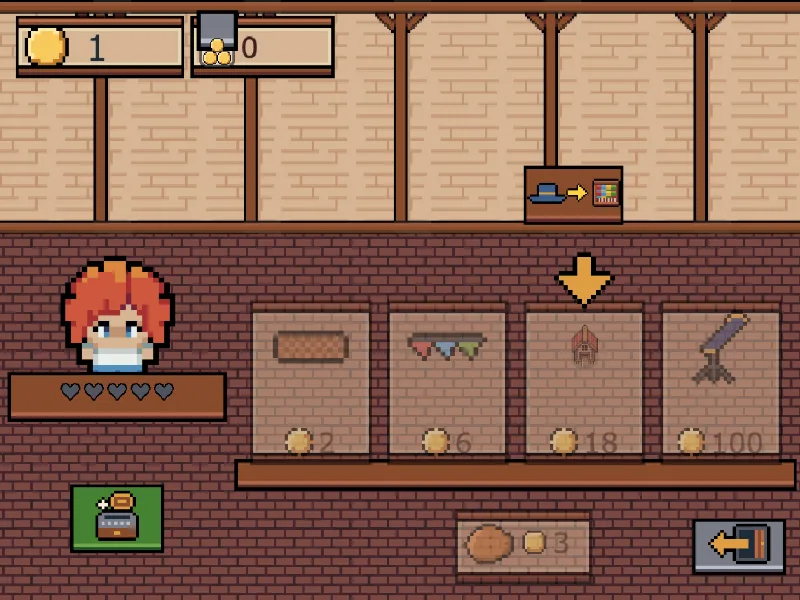
In Pocketvale, a free browser game for children of about 4 to 8, the shop always holds more than one purse can buy. A child picks a wish, puts coins in the jar a few at a time, and buys it when the jar is full. It is the wish list on this page, played out on a screen.
Save for a wish in the game
Free to play in the browser, on an iPad, a tablet or a computer. No ads, no sign-up.
 Play Pocketvale
Questions parents ask
How old should a child be to use a wish list?
About four and up. A child can draw a wish before they can write, and by six or seven many children can write the name and copy the price.
Why wait a week?
Because many wishes fade. A week is long enough for a child to feel the difference between wanting something right now and wanting it still, and short enough that they will remember the list.
Does having a wish list mean I have to buy everything on it?
No. It is a place to put wishes, not a promise. Some will be saved for, some bought on special days, and some dropped.
Can I print it on A4 and on US Letter?
Yes, there is a PDF for each paper size, in black line on white.
More printables: a savings tracker, a needs and wants sort and all our free printables. Related guides: teaching kids to save and needs and wants for kids.